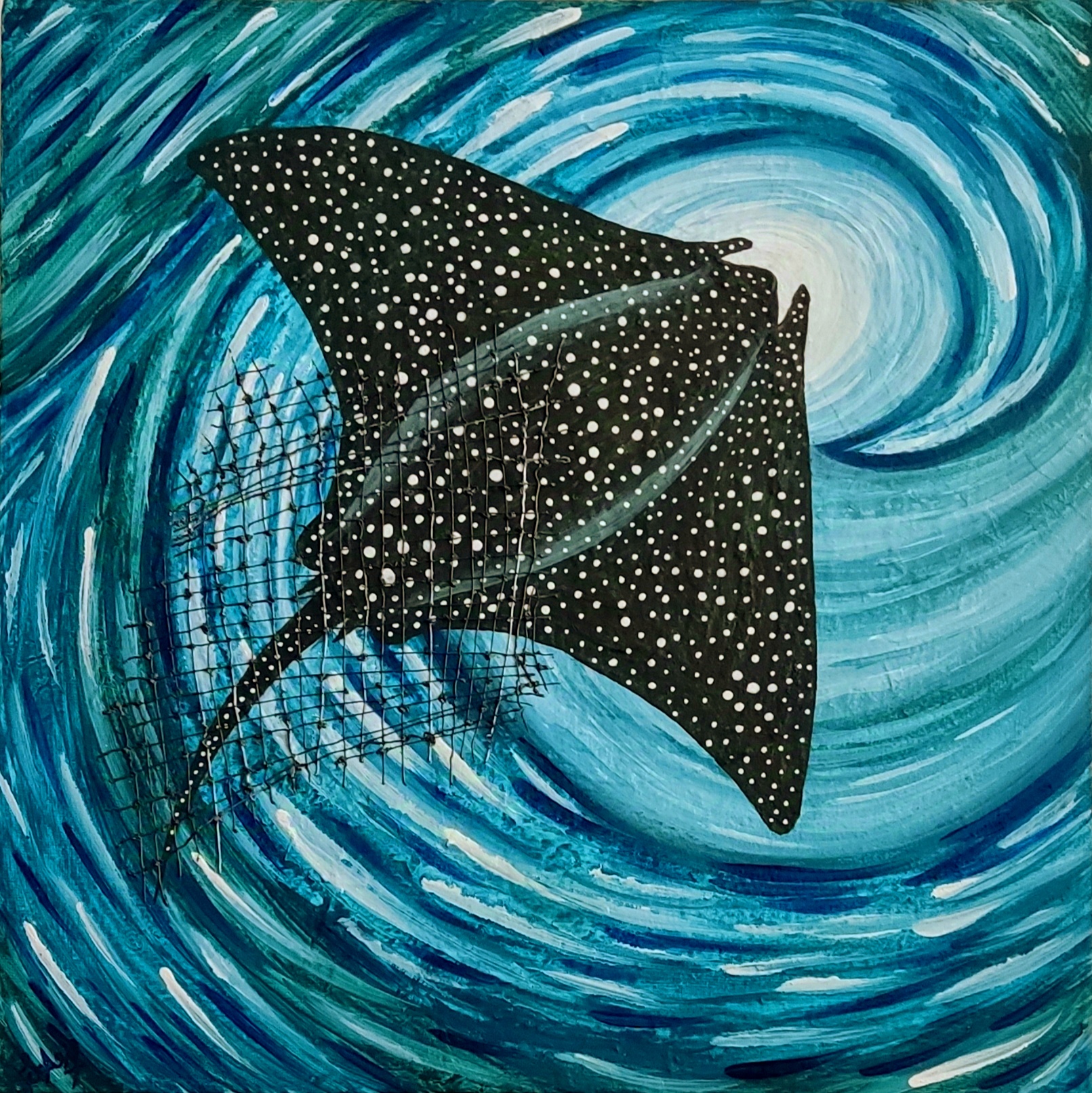
Tis the sport to have the engineer
Mopher Crook
This art piece is created for advancing and funding solutions for the huge problems we face with fast Fashion and mitigate the negative effects it creates to our ecosystems.
The fashion industry is responsible for 8-10% of global emissions – and British shoppers buy more clothes than any others in Europe.
The term describes the quick turnover of fashion trends and the move towards cheap, mass-produced clothing – with new lines constantly released.
Wardrobes are “overflowing with clothes”, argues fast fashion campaigner Elizabeth Cline. Oxfam research suggests the average Briton has 57 unworn items.
Producing clothes uses a lot of natural resources and creates greenhouse gas emissions which are responsible for climate change.
Overall, the fashion industry is responsible for 8-10% of global emissions, according to the UN – more than the aviation and shipping combined.
And global clothes sales could increase by up to 65% by 2030, the World Bank suggests.
Most of fashion’s environmental impact comes from the use of raw materials:
The industry also uses a lot of water. Imagine those small half litre bottles we drink. Well, to manufacture a single t shirt requires 2,700 litres of water – that’s 5,400 bottles. To manufacture a single pair of jeans requires 10,000 litres of water – that’s 20,000 bottles. To manufacture a single pair of cotton socks require 600 litres of water – that’s 1,200 bottles of water.
UK shoppers buy more clothes per person than those in any other country in Europe, according to MPs.
Young people top that list. A recent survey by environmental charity Hubbub found that more than two-fifths of 16 to 24-year-olds buy clothes online at least once a week, compared to 13% on average for other age groups.
Several firms have launched “eco” collections which use organic and recycled materials, including H&M Conscious, Adidas x Parley and Zara Join Life.
But critics argue such collections don’t solve the biggest problem – overconsumption.
We welcome proposed solutions that tackle this sector in multiple areas including manufacturing, supply chain and recycling.

| Material | Oil on canvass |
|---|---|
| Original size | |
| Price | Original Price, Print Price |
| Rarity | Unique |
| Signature | Signed in top corner of painting |
Originally from Malaysia and currently based in London, Auji Azmi is an artist whose work bridges the gap between architectural structure and intuitive fine art. Primarily working in oil paint, I explore the “in-between” spaces of existence—navigating the tension between belonging and freedom, expectation and desire.
Drawing from her background in architecture, her process begins with a grounding framework of shapes or images, within which she allows for emotional spontaneity. By negotiating control and release through layers of texture, she seeks to capture the “feeling of becoming.” Prior to beginning her MA in the UK, she established a strong presence in Southeast Asia with a 2023 multi-city solo exhibition and subsequent 2024 shows at premier galleries like Galeri Puteh. Throughout this journey, her focus has remained constant: crafting ‘sanctuaries’ in her art that allow viewers to find moments of profound beauty and stillness.


Anandi Tamby is a marine microbiologist specializing in microbial membrane biology and adaptive mechanisms to high hydrostatic pressure. She followed her PhD program with Utrecht University. Her research focused on understanding how marine microorganisms modify membrane structure and function to survive in extreme deep-sea environments. Her passion for the ocean goes beyond professional settings, as she loves to dive and dive.
She also writes and curates Science Tambourine (https://sciencetambourine.github.io/ScienceTambourine/), a science communication blog where she explores ocean science, environmental issues, and broader topics in research and discovery for a diverse audience.
A research scientist and data analyst with a Master’s degree in Ecology, Conservation and Evolutionary Biology. Matthew’s work focuses on understanding how environmental factors like climate change, biodiversity loss, and habitat degradation impact ecosystems.
He has experience in data analysis, predictive modelling, and ecological research, using scientific methods to uncover insights and drive informed decision-making. His Master’s research explored the health and fitness dynamics of Carneddau ponies, analyzing biomarkers and their relationship to environmental factors.
Passionate about applying science to solve real-world challenges, using data-driven approaches to inform conservation efforts and sustainable solutions.
Dr. Keerthi Sasikumar is a Climate Scientist with a PhD focused on understanding ocean-atmospheric interactions under warming scenario, particularly how ocean warming drives large-scale climate variability and extreme events. Currently, she is a Postdoctoral researcher at the School of Atmospheric Sciences, SYSU, China, where she studies how atmospheric changes affect solar radiation patterns to better understand and harness renewable energy potential.
Beyond academia, Keerthi has worked extensively on climate risk and climate finance projects, collaborating with corporate clients to quantify potential financial impacts of future climate scenarios. As a climate risk analyst, she has supported businesses develop models to assess the potential business implications of climate-related risks and opportunities.
She is particularly interested in environmental challenges where marine systems intersect with human decision-making. Her work centres on translating complex ocean and climate science into clear, actionable insights that drive practical solutions through interdisciplinary collaboration.
IPO stands for Impact Provenance Original
it’s the score that tracks the environmental purpose and long-term impact connected to this artwork, created through Sycomore’s patented impact system.
An original, hand-crafted artwork created exclusively for the environmental challenge described in this collection.
The artist has personally safeguarded it since completion and releases it only when your offer is accepted, ensuring true rarity and authenticity.
Each Unique Piece is permanently recorded in Sycomore’s Impact Provenance & Ownership (IPO)™ system, a secure, patent-protected ledger available only through Sycomore, certifying origin, mission, and ownership—your lasting proof of both artistic value and environmental impact.
Your artwork is accompanied by a Certificate of Authenticity & Ownership, the definitive proof that it is an original Sycomore creation.
Each certificate carries the Dual Signature™—personally signed by the artist and by the scientist or scientists whose research inspired the work.
This trademarked, patent-protected system is unique to Sycomore, creating a bond between creativity and science found nowhere else.
Every owner and artwork is permanently recorded in the Sycomore Ownership Ledger, our secure, impact-driven registry.