Print Price: £90
Original Price: £1,800
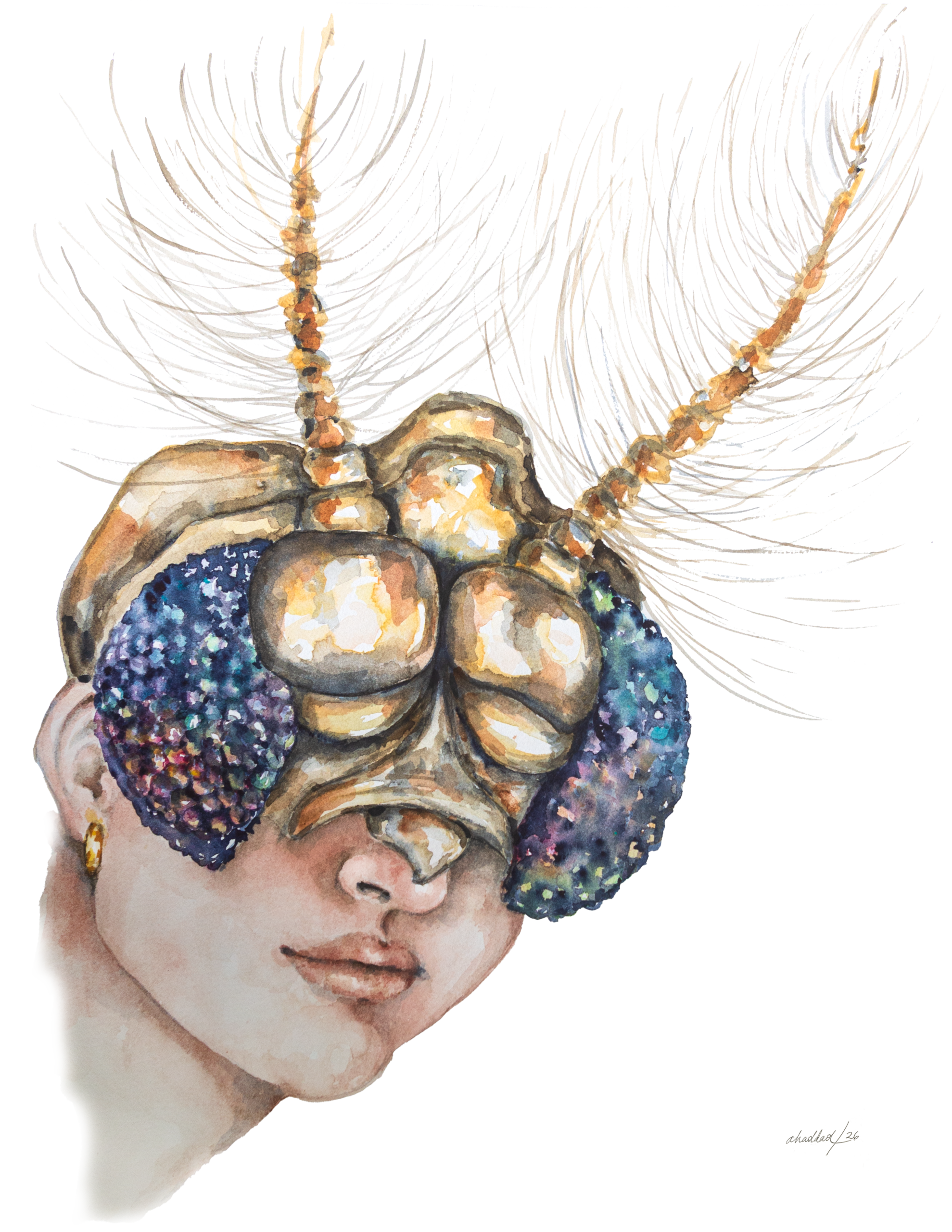
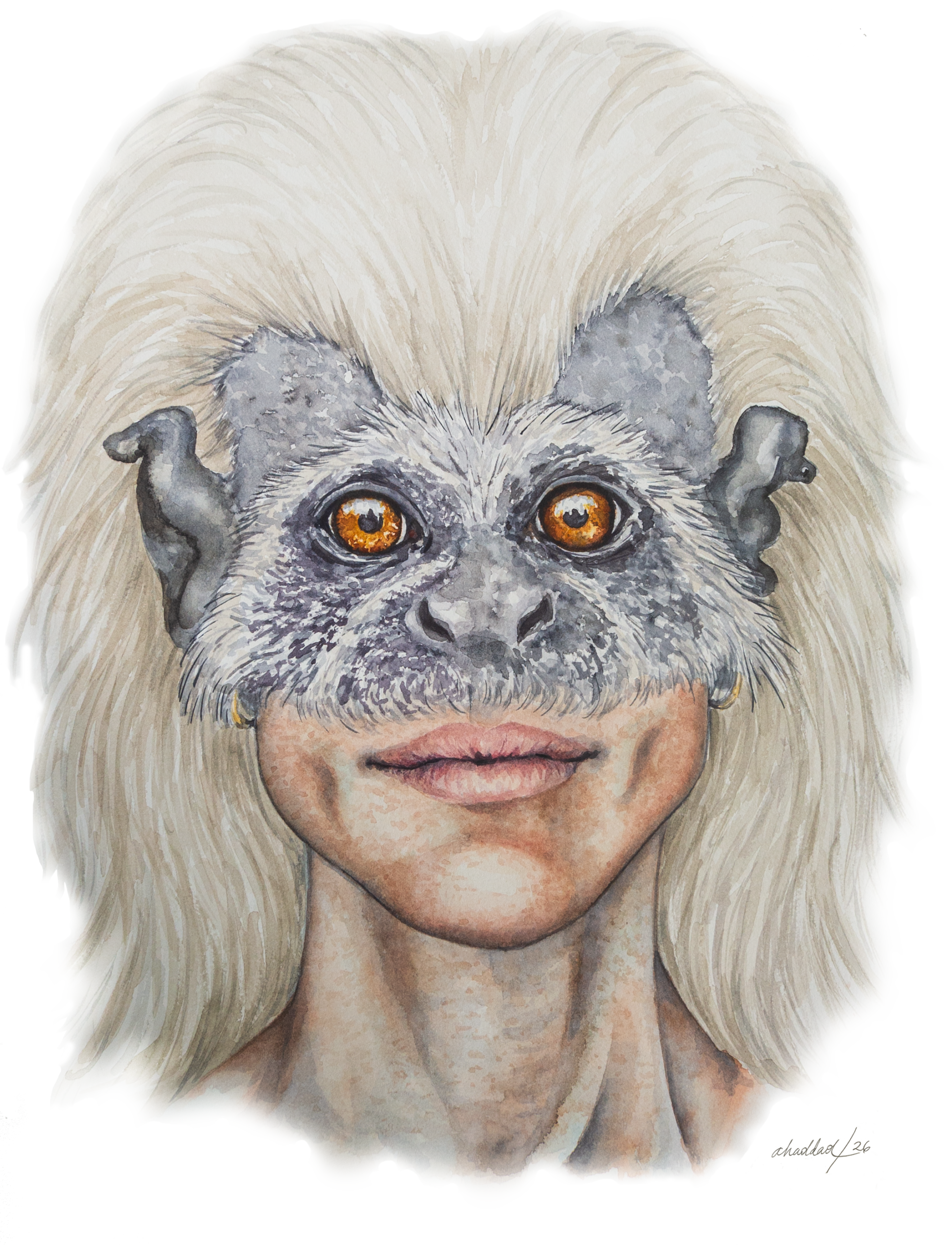
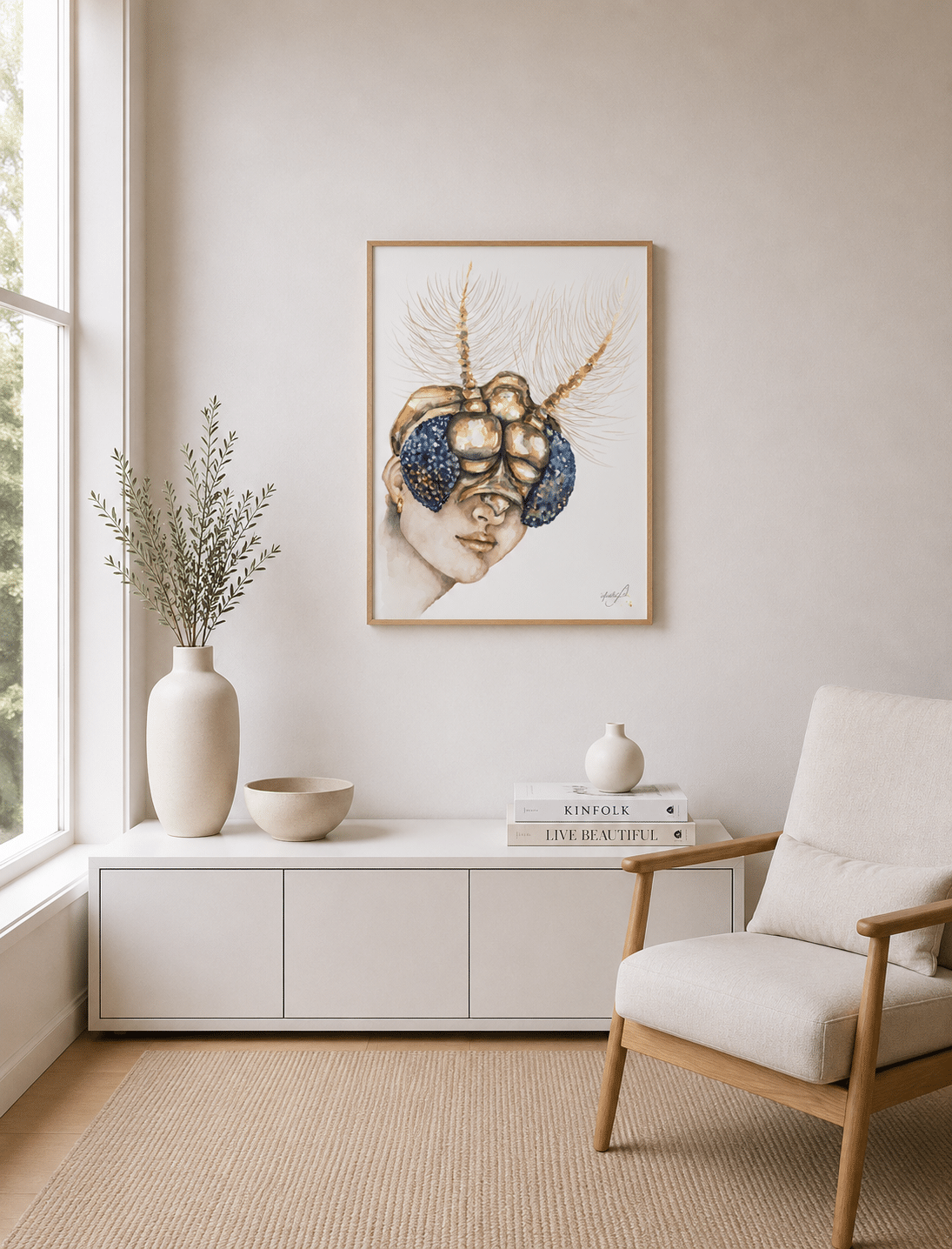
In the cocoa-growing landscapes of Colombia, life depends on invisible alliances. The cotton-top tamarin, critically endangered, disperses seeds and sustains the balance of the forest, while the tiny cocoa midge makes the pollination of the fruit possible. Without them, cocoa would not exist.
At the same time, women cocoa farmers protect these territories with strength and resilience, cultivating not only the land but also the collective memory. Through human-animal hybrids, the work proposes to embody these connections, merging bodies and species to reveal how much we need each other to survive.
Art thus becomes a gesture of empathy and awareness: an invitation to recognize the fragility of these relationships and the urgency of protecting them.
| Medium | Painting |
|---|---|
| Material | Watercolour on paper |
| Original size | |
| Print Size | 29.7 x 42 |
| Rarity | Unique |
| Signature | Signed in bottom corner of painting |
Alexandra Haddad is a visual artist and curator based in Montería, Colombia. She graduated from the École cantonale d’art de Lausanne (ECAL) in Switzerland. Her work has been presented in group exhibitions in Colombia —in Montería and Bogotá— and in Switzerland, including the cities of Lausanne, Biel, Bern, and Geneva. From 2009 to 2014 she worked as support staff in the Visual Arts department of the Ministry of Culture of Colombia.
She has served as curator for the IX (2014), XII (2017), and XIII (2022) editions of the Salón de Arte Bolivariano at the Universidad Pontificia Bolivariana, Montería campus. She was curator and coordinator of the exhibition project UNOS 4 (2015) in Montería, and curator of the group exhibitions Devant l’objectif (2015) and Aequum (2016), organized by the Association Arcos in Geneva, Switzerland.
Her curatorial practice also includes the projects Interior–Exterior: Artistic Exchanges in Times of Pandemic (2020) and Imagen Regional 9 – Caribbean Region (2020–2021), both organized by the Banco de la República. She also curated the second edition of Jagüey, Art Encounters in the Caribbean, organized by the Universidad del Norte.
Her curatorial and artistic practice has been primarily related to social, regional, and environmental themes.


Alexandra Haddad


Paula’s early years were spent in Senegal, Angola, Venezuela, and Spain, before continuing her life journey in Germany and Switzerland. Growing up immersed in such diverse cultures and landscapes, she witnessed firsthand the interconnected and multi-layered challenges faced by both people and forests—and the urgent need to protect them.
Motivated by these experiences, Paola pursued a Master’s degree in Forestry and Environmental Engineering at the Technical University of Madrid (UPM, Spain), followed by a Ph.D. in Civil and Environmental Engineering from the Federal Institute of Technology Lausanne (EPFL, Switzerland). Over more than a decade, she contributed as a scientist at Swiss research institutes like WSL and Agroscope, exploring the impacts of climate change on forests and agriculture.
Recognising the gap between scientific research and practical business solutions, Paula transitioned into sustainability consulting at Quantis. There, she helped forestry and food & beverage companies move beyond business as usual to business at its best—operating within planetary boundaries. Her expertise includes forest carbon accounting, no-deforestation policies, nature-based climate solutions and developing innovative, science-based strategies. She has partnered with global organisations such as WWF, the World Cocoa Foundation and the Science Based Targets initiatives for climate (SBTi) and nature (SBTN).
Beyond her scientific and consulting work, Paola is passionate about empowering the next generation. She currently volunteers as a facilitator for The Earth Foundation in Geneva, empowering teenagers worldwide to transform their sustainability ideas into meaningful action within their communities. Raised in a family of artists and driven by a passion to make science accessible, Paula now collaborates with Sycomore to harness the power of art in fixing the world. Through vivid creativity and compelling storytelling, she believes art can awaken hearts, inspire change, mobilise resources, and unite us all in the urgent quest to address our planet’s climate and biodiversity crises.
Jhon holds a Bachelor’s degree in Government and International Relations from Universidad Externado de Colombia and is currently in the final stage of his Master’s in Public Policy at Universidad Nacional de Colombia.
His research focuses on deforestation in the Amazon and explores how the European Union’s policies could serve as a model for addressing this critical issue. With a strong background in government affairs and public relations, Jhon has worked as a relations specialist, collaborating with diverse stakeholders, including the private sector, public institutions, embassies, multilateral organizations, and civil society.
A Mexican environmental scientist committed to promoting justice for all living beings in the face of unsustainable development. He holds a bachelor’s degree in Environmental Sciences and Health, as well as a master’s and PhD in Environmental Sciences. He currently serves as an associate researcher at the Universidad Autónoma de San Luis Potosí (Mexico), and work as an environmental consultant in the implementation of the Minamata Convention in Mexico.
For nearly a decade Carlos’s work has focused on environmental issues related to chemical pollution from mining and metallurgical activities. He has extensive experience assessing the human health impacts of mercury and arsenic pollution in artisanal mercury mining sites. He has also contributed to ecological risk assessments in areas affected by primary mercury mining and arsenic-copper smelting, many of which are in important natural protected areas. Throughout his academic career, he has published several scientific papers in international journals, participated in national congresses on toxicology and biological conservation, and supported the academic community by supervising undergraduate research projects.
His current approach is grounded in a human and nature rights perspective. He believes that protecting the rights of all living beings is essential, not only to ensure the survival of both human and non-human life in the face unsustainable development, but also to guarantee that all beings can live dignified lives. In this context, and as a member of Sycomore, Carlos believes that the integrating art and science is an innovative and powerful way to help shift away from destructive human development towards a model that respects all life on Earth.
IPO stands for Impact Provenance Original
it’s the score that tracks the environmental purpose and long-term impact connected to this artwork, created through Sycomore’s patented impact system.
An original, hand-crafted artwork created exclusively for the environmental challenge described in this collection.
The artist has personally safeguarded it since completion and releases it only when your offer is accepted, ensuring true rarity and authenticity.
Each Unique Piece is permanently recorded in Sycomore’s Impact Provenance & Ownership (IPO)™ system, a secure, patent-protected ledger available only through Sycomore, certifying origin, mission, and ownership—your lasting proof of both artistic value and environmental impact.
Your artwork is accompanied by a Certificate of Authenticity & Ownership, the definitive proof that it is an original Sycomore creation.
Each certificate carries the Dual Signature™—personally signed by the artist and by the scientist or scientists whose research inspired the work.
This trademarked, patent-protected system is unique to Sycomore, creating a bond between creativity and science found nowhere else.
Every owner and artwork is permanently recorded in the Sycomore Ownership Ledger, our secure, impact-driven registry.